Designing flat-pack furniture for a 3% damage rate
Why 3% is a realistic target and where the remaining loss actually occurs
A 3% damage rate sounds high until you compare it with the industry norm for flat-pack furniture moving through ocean freight and two or three handling nodes. Reported loss rates for imported ready-to-assemble furniture commonly run between 2% and 8%, depending on the carton design, the container load plan and the number of transfers. A 3% target is not a promise of perfection; it is a working ceiling that separates a controlled packaging program from an uncontrolled one.
The loss is not distributed evenly. In a typical program, carton crush and corner damage account for roughly half of all claims, surface scratches and edge dents account for about a quarter, missing or damaged hardware accounts for around 10%, and the rest is moisture, contamination and handling damage at the retail dock. That distribution matters because the remedies are different: crush needs structural packaging, scratches need surface protection, and hardware needs a different packing method.
The last leg is often the most damaging. Retail distribution centers and last-mile delivery handle cartons more aggressively than the ocean carrier, and a carton that survives a trans-Pacific voyage can still be crushed by a rooftop pallet or a forklift at the store. A damage program that tests only the port-to-warehouse leg is measuring the easiest part of the journey.
Design decisions that reduce damage before packaging
The cheapest damage reduction happens in the design, not the carton. Rounded or chamfered edges resist impact better than sharp corners, because a sharp corner concentrates stress and transfers it into the panel. Recessing hardware into a pocket, or placing it in a separate hardware bag, keeps a metal part from prying open a carton seam under load. A leg that folds flat without a protruding screw head will survive a side drop that would otherwise punch through the panel.
Nesting reduces both volume and damage. Parts that nest with controlled clearance distribute impact across a larger contact area, while parts that touch at a single point create a pressure concentration. The nesting geometry should be designed so that the load path runs through the strongest part of the panel, and so that movement inside the carton is limited to a few millimeters. Foam or corrugated spacers can control that movement, but they should not be used to compensate for a geometry that cannot stack.
Weight distribution inside the carton is the third design lever. A heavy metal frame packed against a thin veneered panel will dent it under a modest drop. Separating heavy and light components with a corrugated divider, and placing the heaviest item at the bottom of the carton where it is supported by the base, reduces peak loads on fragile parts. Hardware should be packed in a compartment that does not press on a finished surface, and every sharp fastener should be bagged or taped so it cannot migrate during transit.
ISTA-3A test sequence and how to interpret a partial failure
ISTA-3A is the general simulation test for parcel delivery shipments, and it combines conditioning, atmospheric pre-treatment, random vibration, rotational edge and corner drops, and a final drop sequence. The conditioning step brings the packaged product to a specified temperature and humidity before the mechanical test, because corrugated board loses a significant share of its compression strength at high humidity. Skipping conditioning produces an optimistic result that does not reflect a real container.
The test sequence is progressive, and a partial failure is informative rather than disqualifying. If the carton survives vibration but fails the corner drop, the problem is local corner protection rather than overall board strength. If it fails vibration at the carton seams, the issue is usually load containment or board grade. If it survives the mechanical sequence but the product shows scratches after unpacking, the problem is internal contact protection rather than the carton itself.
The interpretation depends on the intended distribution channel. A product shipped to a retail distribution center will see more handling than a product shipped directly to a consumer, and a product that will be stacked in a warehouse needs a compression test as well as a drop test. The test report should record the exact sequence, the drop heights, the orientations, the conditioning conditions, the observed damage and the pass or fail criterion. A report that says “passed ISTA-3A” without those details cannot be used to compare suppliers or to diagnose a later failure.
Corner crush protectors, honeycomb and moulded pulp
Corner protectors are the most cost-effective single addition to a flat-pack carton. A moulded pulp, expanded polystyrene or laminated corrugated corner increases the effective corner crush strength by distributing impact over a larger area, and it typically adds a small cost per unit. Protectors should cover the full height of the corner and be held in place by the carton structure rather than by tape, because tape releases in humid conditions.
Honeycomb paperboard is the next tier. It offers high compression strength for its weight, it is recyclable in most markets, and it can be die-cut to match the panel outline. Honeycomb is particularly effective for a heavy flat panel that would otherwise flex under a stack load. Moulded pulp is a stronger but heavier alternative, and it can be shaped to hold hardware and small parts as well as to protect corners. Expanded polyethylene foam is the most protective option and the most expensive, and it is usually reserved for high-value or fragile components.
The cost comparison should be made per protected unit, not per carton. A corner protector that costs a few cents and reduces the claim rate by half a percentage point can pay back many times over, while a premium foam insert that doubles the packaging cost and reduces claims by 0.1% may not. The calculation should include the packaging cost, the freight cost of the additional volume, the claim cost and the customer-service cost of handling a claim. For most programs, a mid-tier solution with good corner protection outperforms both the cheapest and the most expensive option.
Master carton stacking limits and container-load planning
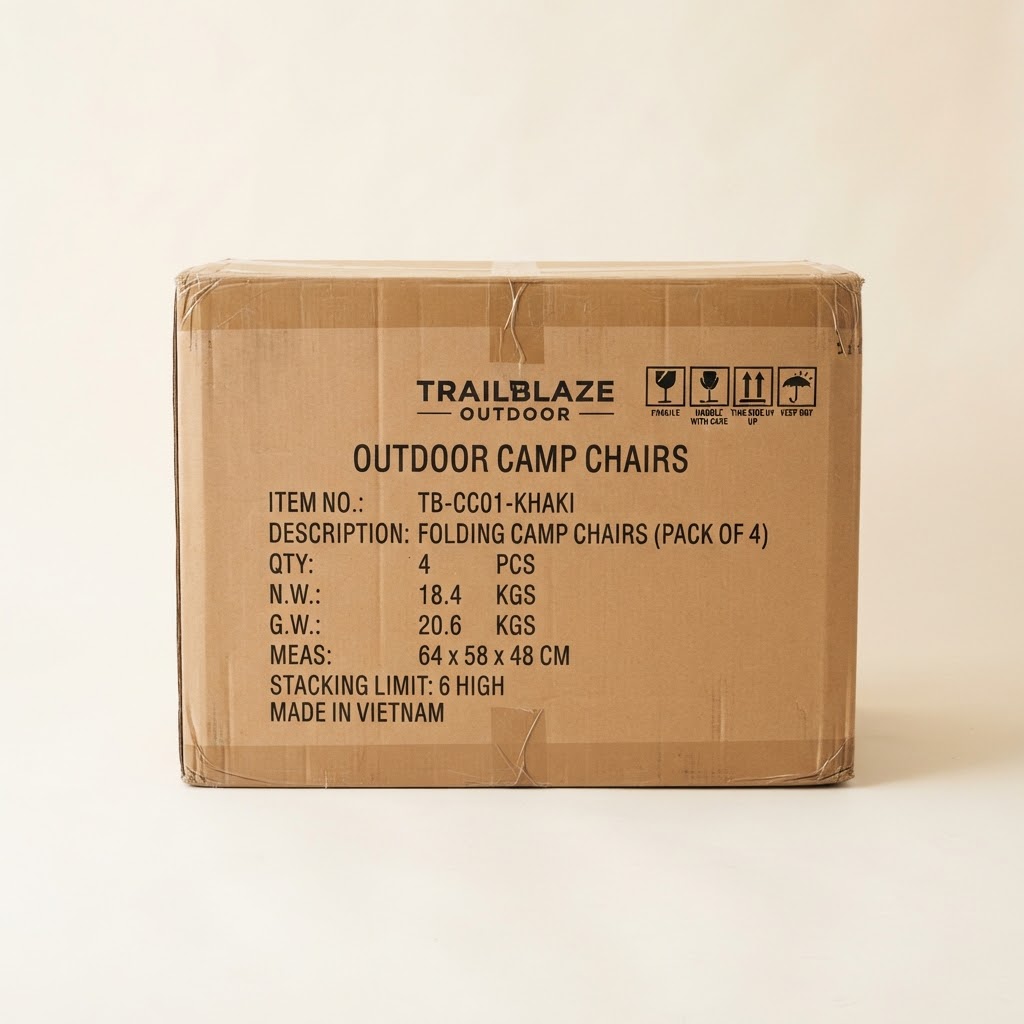
The master carton must be designed for the stack it will actually see, not for the stack that is convenient in the warehouse. A typical 40-foot high-cube container accepts cartons stacked roughly 2.4 to 2.7 meters high, and the bottom carton carries the weight of everything above it. Corrugated board loses compression strength over time and at high humidity, so the safe load is typically derated to 40% to 60% of the short-term compression test value for a voyage of several weeks.
Palletization changes the load path. Floor loading usually increases the usable volume, but it also increases the compression requirement and the risk of damage during de-stuffing. The choice should be made early, because it determines the board grade and the carton dimensions.
A damage-tracking loop that feeds field data back into the carton specification
A damage rate is only meaningful if the claims are recorded in a consistent format. Each claim should capture the carton condition, the failure location, the damage mode, the production batch, the carton supplier and the handling stage. A photo of the damaged carton and the damaged part is more useful than a text description, and a short defect code list keeps the data comparable across a year.
The data should be reviewed on a regular cycle, not only when a major claim occurs. A monthly review of damage by carton type, by SKU and by destination identifies which cartons are failing and whether the failures cluster in a particular channel. A carton that fails only on the west coast may be a humidity problem; a carton that fails only at one retailer may be a handling problem; a carton that fails across all channels is a design problem.
Every corrective action should be tied to a test. If the review shows corner damage concentrated in one carton size, the fix should be a corner protector change validated by a repeat drop test, not a general instruction to handle more carefully. The loop closes when the revised carton is tested, released to production, tracked against the same claim codes, and confirmed to have moved the damage rate in the intended direction.