A buyer’s guide to 6061 vs 5052 aluminum in outdoor furniture
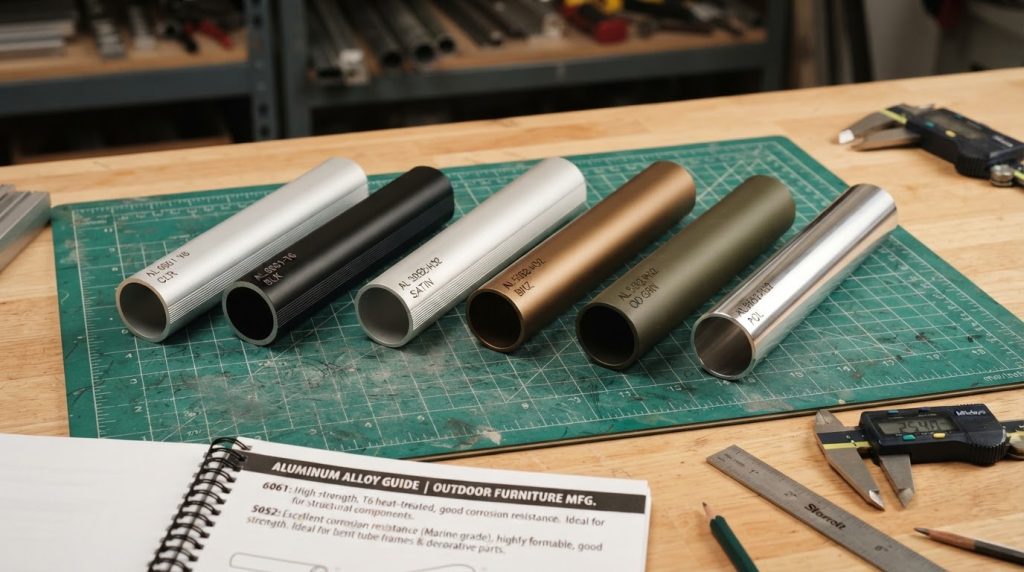
Why the forming process decides the alloy before the datasheet does
Buyers often start the 6061 versus 5052 conversation with a yield-strength comparison, but the choice is usually settled earlier, by the forming process. A part that has to be bent to a tight radius, rolled into a curved slat or stretch-formed into a shell will favor 5052-H32. A part that is extruded, machined or bolted into a structural frame will usually favor 6061-T6. Reading the datasheet first tends to produce an over-specified part that cannot be manufactured economically.
The practical question is not which alloy is stronger, but which one can reach the required geometry with an acceptable reject rate. A 6061-T6 tube that is 15% stronger than a 5052-H32 alternative is not an improvement if half the bends crack during forming or show orange peel after anodizing. At the quotation stage, the factory needs to know the bend radius, the grain direction, the finish and the joint method before it can recommend a temper.
It also helps to separate the parts of the product. A single outdoor chair may use extruded 6061-T6 for the frame, 5052-H32 sheet for the seat slats, die-cast or machined 6061 for the arm brackets, and stainless steel for the fasteners. Treating the whole bill of materials as one alloy decision is a common source of either excess cost or avoidable field failures.
Mechanical comparison in the tempers mills actually stock
In the tempers most extrusion and sheet mills keep available, 6061-T6 has a typical yield strength of about 276 MPa (40 ksi), a tensile strength of about 310 MPa (45 ksi) and elongation of roughly 12%. 5052-H32 has a typical yield strength of about 193 MPa (28 ksi), a tensile strength of about 228 MPa (33 ksi) and elongation in the range of 12% to 18%. The strength gap is real, but it is smaller than the difference in forming behavior.
Fatigue behavior reverses part of the ranking. Published endurance limits for 6061-T6 are often quoted near 95 to 100 MPa, while 5052-H32 is often quoted near 110 to 120 MPa. Surface finish, weld toes, sharp corners and anodize quality can dominate those numbers in practice. For a slat that flexes under wind or a chair that rocks, 5052 ductility and fatigue performance are usually more valuable than 6061 static strength.
Stiffness, however, is nearly identical. Both alloys have a modulus of elasticity around 69 GPa, so switching from 5052 to 6061 does not make a frame meaningfully stiffer. Deflection is controlled by geometry, not by alloy. If a frame flexes too much, the answer is usually a larger section, a different joint detail or a gusset, not a higher-strength temper.
Corrosion in coastal hospitality: chloride exposure and pitting
Both alloys form a protective oxide layer, but they behave differently in chloride-rich air. 5052 contains no intentional copper addition and is generally the more forgiving choice for marine and coastal environments. 6061 contains roughly 0.15% to 0.4% copper, which improves strength but can form cathodic phases that support pitting when the oxide layer is damaged. In a beachfront hotel or an outdoor cafe within a few hundred meters of salt water, that difference matters.
At the coast, anodize quality often matters more than the alloy choice. A properly sealed Type II anodize at 15 to 25 micrometers, or a Type III hard anodize where wear is a concern, provides a barrier that keeps chlorides away from the substrate. Thin, unsealed or dyed-only finishes fail quickly at edges, cut ends and threaded holes. Powder coating can perform well, but it depends on a pretreatment appropriate for aluminum and on adequate coverage at sharp edges.
Design details decide how long the finish survives. Water should drain rather than sit in crevices. Dissimilar metals should be isolated with nylon washers, isolating sleeves or a suitable sealant. Cut ends should be sealed or positioned so they are not exposed to standing water. For critical projects, a salt-spray test per ASTM B117 with a scribe, combined with periodic field inspection, provides more useful evidence than a certificate alone.
Forming limits: minimum bend radius and springback
5052-H32 is the more formable alloy. For sheet thicknesses between roughly 1 mm and 3 mm, a minimum inside bend radius on the order of one times the material thickness is a reasonable starting point, although tight radii in the transverse grain direction need a trial bend first. 6061-T6 is much less forgiving: minimum inside radii of 2.5 to 4 times thickness are common, and tighter bends frequently require annealing to an O or T4 temper, forming, and then aging back to T6.
Springback also differs. 5052-H32 typically springs back a few degrees, while 6061-T6 can spring back 10 to 20 degrees depending on radius, thickness and tooling. That difference has to be built into the die or compensated by over-bending. Bending across the grain rather than with it reduces the risk of cracking in both alloys, and deburred, lubricated edges reduce the chance of a crack initiating at a shear mark.
The most expensive forming defects appear late. A bend may look acceptable before finishing and reveal micro-cracks only after anodizing, because the anodize layer is brittle and the dye highlights the crack. The same bend may show orange peel or a rough surface after powder coating because the substrate was stretched beyond its limit. For any bend that will carry structural load, a 10x visual check plus dye-penetrant testing after forming is a reasonable control.
Weldability and post-weld strength loss in the heat-affected zone
6061-T6 loses a significant share of its strength when welded. The heat-affected zone can drop to roughly 140 to 170 MPa yield strength, which is about half of the parent-metal value, depending on the weld procedure and the amount of heat input. 5052-H32 is a non-heat-treatable alloy, so it does not suffer the same precipitation-related loss; the weld and adjacent zone are softened by the thermal cycle, but the joint generally retains a much higher fraction of parent strength.
Filler selection matters for both. 4043 and 5356 are common choices for 6061, with 5356 offering higher shear strength and 4043 offering better crack resistance and easier feeding. 5052 is commonly welded with 5356. Preheat is rarely required for thin sections and can increase distortion, while excessive heat input widens the softened zone and raises the risk of porosity. Clean, oxide-free surfaces and a stable shielding-gas supply are more important than a high travel speed.
Designers should assume that a welded 6061-T6 joint is no longer a T6 joint. Put welds in low-stress regions, add material around the joint if the load path requires it, and consider a proof-load or destructive test on a first article. Post-weld solution treatment and aging is possible in a furnace, but it is impractical for large welded frames and can introduce distortion that costs more than the strength it recovers.
A practical selection table and purchase-order language
A workable default for outdoor furniture is 6061-T6 for extruded frames, legs and structural brackets; 5052-H32 for flat or formed slats, panels and curved components; and 304 or 316 stainless steel for fasteners, with 316 preferred within roughly one kilometer of the coast. Where a 5052 part is structurally marginal, increasing the section is usually cheaper and more predictable than switching to 6061-T6 and fighting the forming limits.
The purchase order should name the alloy and temper, not just the metal. For extrusions, reference ASTM B221 and the required temper; for sheet, reference ASTM B209. Require a certificate of analysis for chemistry and mechanical properties, and specify the finish separately: anodize type, class, color and minimum thickness per MIL-A-8625 or AAMA 611, or powder-coat chemistry and film thickness per the relevant AAMA specification.
Finally, agree on the evidence. A first-article inspection, a bend test on the tightest radius, a salt-spray result where the application warrants it, and lot-level traceability from the mill to the finished part are all reasonable requirements. A generic line item that says aluminum invites the supplier to choose whatever is cheapest on the day, which is rarely the alloy the design actually needs.